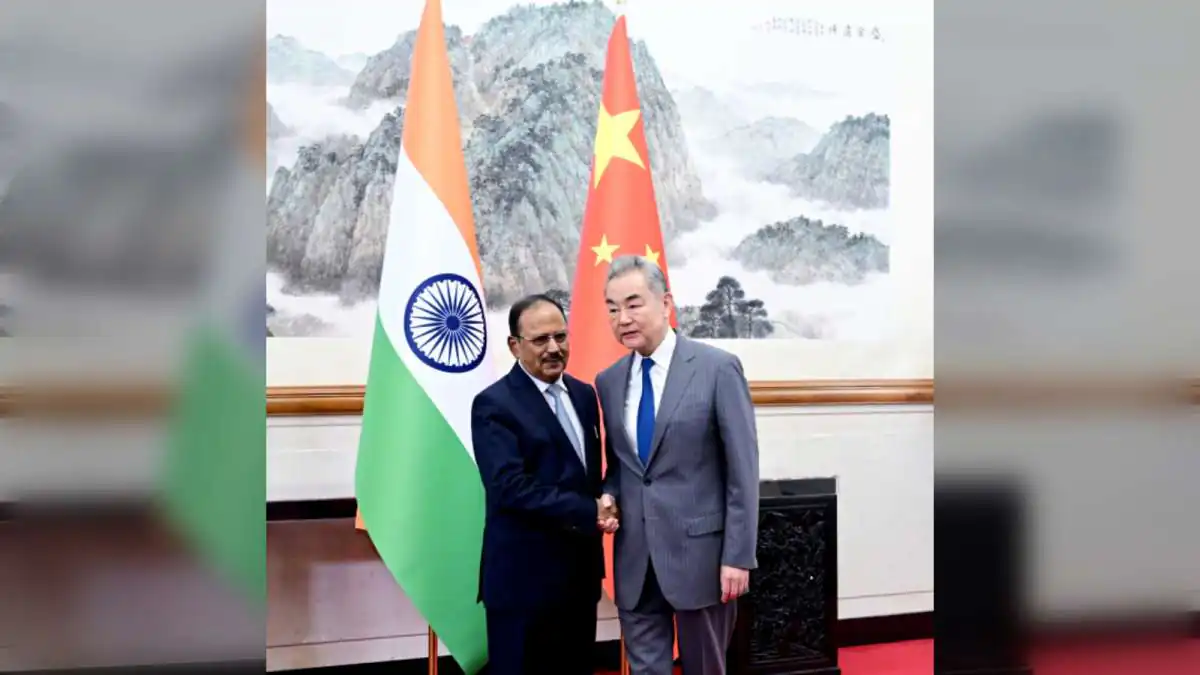
China has once again publicly indicated that it is ready to actively work with India on rebuilding a stable, forward-looking bilateral relationship. Terming both countries as important neighbours and representatives of the major developing economies of the Global South, Beijing on Tuesday said it is willing to enhance understanding, eliminate differences, overcome obstacles and be good neighbours and friends with New Delhi. The statement came against the backdrop of the 25th meeting of the Special Representatives on the China-India Boundary Question, held in Beijing between National Security Advisor Ajit Doval and Chinese Special Representative Wang Yi.
The framing chosen by Wang Yi to describe the desired trajectory of the relationship was particularly striking. Wang Yi highlighted the goal of achieving a "harmonious coexistence" between the dragon and the elephant during the talks — a phrase deliberately loaded with civilisational imagery and geopolitical weight. In the language of Chinese diplomacy, this framing signals an intent to place the India-China relationship in a long-term, strategic context, rather than allowing it to remain hostage to short-term tensions.
Doval-Wang Yi Talks: Substantive and Candid
The 25th Special Representatives meeting was described in official Chinese communication as a comprehensive, in-depth, friendly and candid engagement. NSA Ajit Doval and Wang Yi — the Chinese Special Representative, Member of the Political Bureau of the CPC Central Committee, and Director of the Office of the Central Foreign Affairs Commission — used the platform to review both the specific boundary question and the broader trajectory of bilateral relations. In diplomatic terms, the choice of adjectives ("comprehensive", "candid") signals a genuine, substantive dialogue rather than a routine engagement.
Wang Yi's Framing of the Relationship
Wang Yi placed the bilateral relationship in a larger global context. "Wang Yi stated that China and India are important neighbours and representatives of major developing countries and emerging economies. The healthy and stable development of China-India relations is in the fundamental interests of both peoples, meets the common aspirations of countries in the Global South, and aligns with the trend of the times. China-India relations have transcended the bilateral scope and possess global and strategic significance," he was quoted as saying by China's Ministry of Foreign Affairs.
The Modi-Xi Momentum
Wang Yi also acknowledged that the top-level political tone between Beijing and New Delhi has been actively evolving. "In recent years, President Xi Jinping and Prime Minister Modi met twice in Kazan and Tianjin, reaching a series of important consensuses that have charted the course for the improvement and development of bilateral relations. China is willing to work with India to grasp bilateral relations from a strategic and long-term perspective, strengthen communication, enhance understanding, eliminate differences, overcome obstacles, and be good-neighbourly and friendly friends and mutually beneficial partners, achieving a harmonious coexistence between the dragon and the elephant," he added.
NSA Doval's Approach: Stability, Predictability, Vision
In his remarks, NSA Ajit Doval underscored the need for developing a stable, predictable and forward-looking India-China relationship — one that remains in the common interest of both peoples and holds great significance for Asia and the world. His framing was measured and pragmatic — an acknowledgement of the significant work required to fully normalise the relationship, combined with a clear recognition of the strategic importance of getting the equation right.
Ground Reality: Border Peace and Return to Track
Doval also emphasised that, under the guidance of the leaders of both countries, India-China relations have "returned to the right track". He noted that border areas have maintained overall peace, and that exchanges and cooperation across various fields have steadily progressed. This assessment is significant because it points to a substantive stabilisation of the situation on the ground — a critical foundation for any deeper diplomatic normalisation.
The Boundary Question: A Multi-Layered Dialogue
According to the Chinese Foreign Ministry, both sides engaged in in-depth discussions on multiple aspects of the boundary question — advancing border demarcation negotiations, strengthening border control, improving mechanisms and promoting cross-border cooperation. That layered agenda reflects the reality that the India-China boundary issue is not a single dispute — it is a set of interlocking issues that require sustained, structured dialogue.
The Next Round: 2027 in India
Both sides agreed to hold the 26th meeting of the Special Representatives on the China-India Boundary Question in India in 2027. This continuity of dialogue is arguably one of the most important outcomes of the current round — the very fact that both sides have committed to another structured engagement demonstrates a shared understanding that dialogue, not disruption, is the preferred pathway forward.
Why It Matters: A Pattern of Deliberate Warmth
Beijing's tone in the current round is consistent with a broader pattern of deliberate diplomatic warmth from the Chinese side towards India in recent months. From leader-level meetings in Kazan and Tianjin to Foreign Minister-level exchanges to Special Representatives-level dialogues, the Chinese messaging has increasingly leaned into partnership, coexistence and long-term engagement. That evolution matters — because tone often shapes the substance of future negotiations.
India's Position: Engaged, Firm and Strategic
New Delhi's position, as reflected in Doval's remarks, is one of engaged firmness. India remains fully open to dialogue and pragmatic cooperation, but continues to insist on stability, predictability and border peace as non-negotiable foundations. That combination of engagement and clarity is a mature diplomatic posture, and one that has arguably contributed to the current forward momentum in the relationship.
Cross-Border Cooperation: The Emerging Frontier
The Chinese statement's specific reference to promoting cross-border cooperation is a small but significant detail. It signals that both sides are looking beyond a purely boundary-management framework, and are willing to consider tangible people-to-people, trade-linked and community-level engagements that can gradually build trust along the boundary areas. Such initiatives, if executed carefully, can meaningfully reduce mistrust over time.
Why It Matters: The Global South Framing
Wang Yi's positioning of India-China relations within the broader Global South framework is worth examining closely. It reflects a growing global reality — that the world is entering a phase where the collective voice of major developing economies and emerging markets will increasingly shape international economic and political agendas. India and China, together, form the core of that voice. Any long-term normalisation between the two, therefore, would carry not just bilateral but truly global significance.
Industry Impact: Business Sentiment Follows Diplomatic Tone
For the corporate ecosystems in both countries — from technology and manufacturing to pharmaceuticals, telecom, education and tourism — every incremental improvement in the political relationship carries meaningful commercial implications. Cross-border investments, joint ventures, supply chain integrations and even student exchanges tend to move in step with the tone at the top. A durable diplomatic reset, if it materialises, could unlock significant new commercial energy across both markets.
The Regional and International Backdrop
The current diplomatic reset is also unfolding in an environment shaped by broader geopolitical shifts — evolving US-China relations, Russia-Ukraine dynamics, Middle East volatility, and the accelerating global focus on supply chain diversification. In such an environment, India and China each have strong reasons to seek stability in their bilateral equation. Neither country benefits from an unmanaged tension escalation, and both stand to gain from a normalisation that gives them more strategic bandwidth for wider global engagement.
Audience Sentiment: Cautious Optimism
Public sentiment on both sides of the border is likely to interpret the current round of talks with cautious optimism. Years of periodic tension mean that neither Indian nor Chinese audiences are quick to embrace declarations of friendship. However, the sustained, structured, dialogue-driven approach both sides have taken over the past year is helping build the kind of quiet confidence that eventually produces durable outcomes.
Why It Matters: The Long Game of Diplomacy
India-China diplomacy has always been a long game. Trust is built slowly, and shocks can undo years of engagement quickly. The Chinese Foreign Ministry's statement, combined with the tone of the Doval-Wang Yi dialogue, is a signal that both sides recognise the need to move deliberately, avoid missteps, and lock in progress through repeated structured engagement. The scheduled 26th Special Representatives meeting in India in 2027 is precisely that kind of long-game commitment.
The Border Mechanisms Emphasis
The specific emphasis on "improving mechanisms" for border control and management is another important, if under-covered, element of the current dialogue. Boundary disputes globally are rarely resolved through single big breakthroughs; they are more often stabilised and eventually settled through the slow but critical work of institutional mechanism-building. The willingness of both sides to invest in these mechanisms is itself a form of quiet progress.
The Bigger Picture: Redefining Asia's Two Largest Powers
At its heart, the current phase of India-China diplomacy is about defining the terms on which Asia's two largest civilisational states, and its two largest population centres, will coexist over the coming decades. Coexistence, in that context, is not simply about avoiding conflict — it is about actively shaping a relationship that respects sovereignty, safeguards national interests, and yet remains open to structured cooperation on issues of shared concern.
What to Watch Next
Going forward, the areas to watch include the pace of border demarcation negotiations, the tone of subsequent diplomatic exchanges, the trajectory of any people-to-people engagement, and, critically, whether the political momentum from the Modi-Xi meetings continues to translate into concrete outcomes at the working level. The 2027 meeting in India will be a key marker of how much progress has been made — and how much more work still lies ahead.
The Bottom Line
Beijing's message on Tuesday was, in essence, that China is ready to walk further along the path of a stabilised, structured, forward-looking relationship with India. New Delhi's message, delivered with characteristic pragmatism, was that this walk must be built on the twin foundations of border peace and strategic predictability. Both sides used the language of long-term partnership, and both agreed to keep the conversation going with another structured engagement in 2027. In a world where diplomatic relationships are increasingly fragile, and where the temptation to abandon dialogue often looms large, the choice by both India and China to keep talking — carefully, respectfully, and substantively — is itself a meaningful outcome. If the "harmonious coexistence of the dragon and the elephant" that Wang Yi spoke about is to eventually take shape, it will do so exactly through moments like these — patient, professional, and quietly consequential.
Also Read: India-China Border Trade Resumes After Decades; Rare Minerals, Fertilizers at Core of $5-6 Billion Deal

















































.jpg)