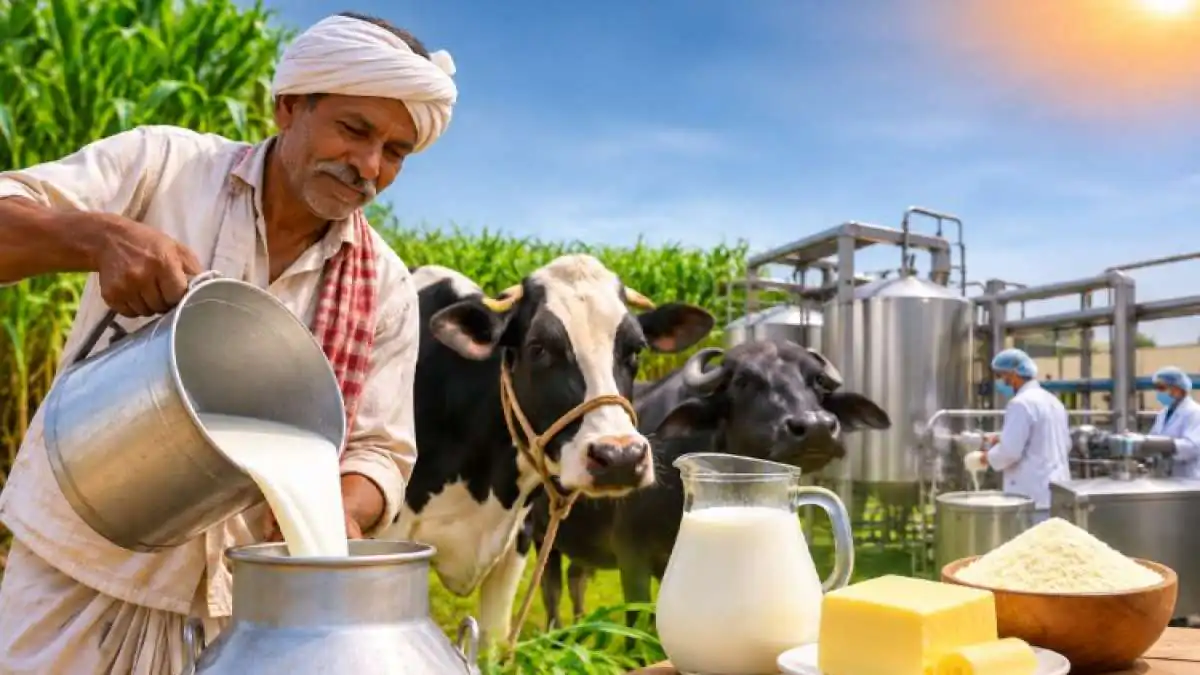





























































El Niño is also likely to affect the availability of fodder, which would hamper India's dairy industry in the coming year. Experts predict that the effect of El Niño would be felt up till February-March next year.
In this scenario, a decline in the availability of fodder will cause the growth rate of milk production to fall to two percent. This will definitely have an impact on the income level of small farmers rearing livestock.
The production of milk is expected to grow by 2.5 percent in 2026 due to the increased availability of fodder owing to better monsoons last year; however, this trend is not likely to continue in the coming year. Hence, the cost of fodder will rise, followed by the cost of milk production.

A recent report by the US Department of Agriculture states that despite being the world's largest milk producer, India's livestock population is increasing, but milk production per animal remains low compared to other countries.
As a result, milk production is expected to increase by only two percent to 226.5 million tons in 2027. A shortage of animal feed and small and scattered dairy farms are the main reasons for this.
Approximately 95 percent of the country's milk producers own one to five animals. Approximately 80 million rural households are involved in dairy activities. The dairy sector contributes approximately five percent to GDP. Consequently, even a slight decline in production can impact the rural economy and the income of small farmers.
The dairy sector's biggest weakness is the lack of fodder availability. The Indian Grassland and Fodder Research Institute (IGFRI) also believes that there is an 11 to 32 percent gap between the demand and availability of green fodder in the country. This gap is 23 percent for dry fodder and 28 to 40 percent for concentrated feed.
In such a situation, if the impact of El Niño continues, the fodder crisis facing livestock farmers could deepen. Despite the slowdown in milk production growth, demand for milk and dairy products will remain unchanged. Domestic consumption of liquid milk is expected to reach approximately 95 million tons in 2027 due to rising incomes, urbanization, and the expansion of the organized retail market.
Milk intake for processing purposes is projected to be 131.5 million tons. Butter production is projected to rise to 7.6 million tons, an increase of 2.2 percent, and the production of skimmed milk powder is estimated to rise by 2.5 percent to 81 million tons.
There will be a difference in demand and supply that will affect the export situation as well. In the year 2027, butter exports are likely to fall from 45,000 tons to 40,000 tons. Likewise, exports of skimmed milk powder will fall from 15,000 tons to 7,000 tons. Milk exports are also projected to decline from 30,000 tons to 25,000 tons.