Saturday marks an important event in the history of India’s space programme. India, a nation that started transporting rocket components on cycles and bullock carts and became the thrifty and precise space program managed by ISRO, will now move ahead, supported by private enterprises.
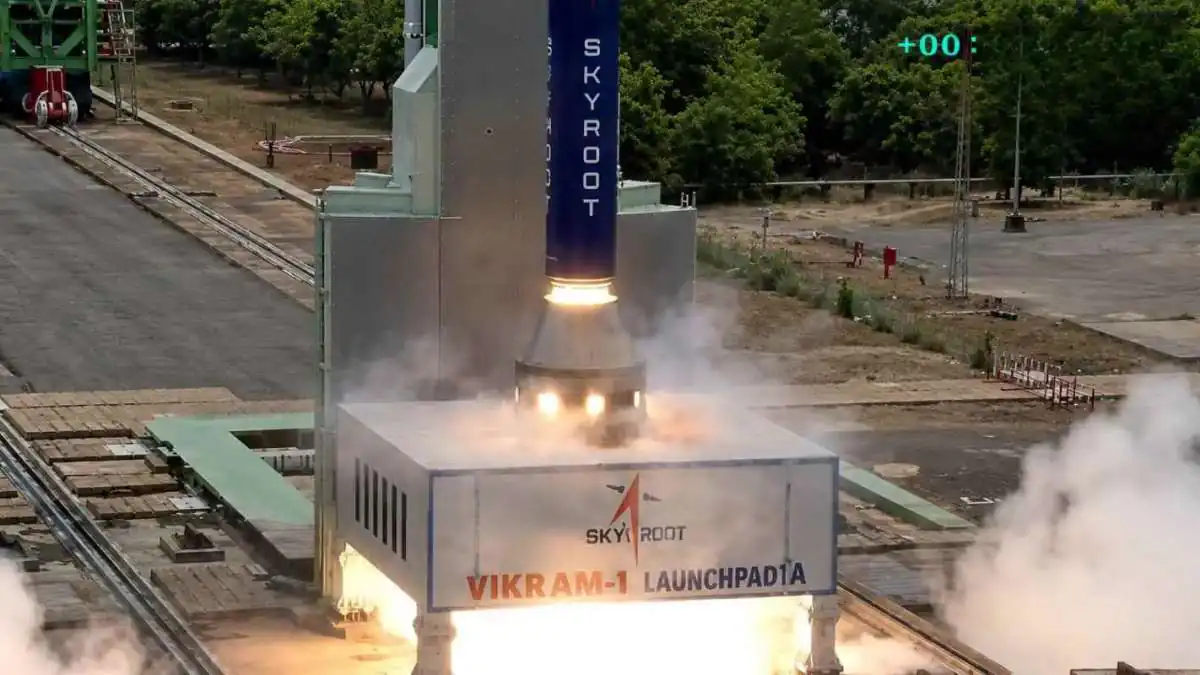
An Indian private enterprise from Hyderabad, Skyroot Aerospace, aided India to join the new space economy by launching the Vikram-1 rocket made mainly of Indian components from the Satish Dhawan Space Center in Sriharikota. It is India’s first privately made rocket to be launched into Low Earth Orbit (LEO).
With this achievement, India became the third country in the world-after the USA and China-to possess private-sector orbital launch capabilities. Key figures present at the launch included Skyroot founders and former ISRO scientists Pawan Kumar Chandana and Naga Bharath Daka, ISRO Chairman V. Narayanan, a former ISRO chief, and astronaut Shubhanshu Shukla.
According to PTI, the four-stage Vikram-1 rocket-which lifted off at 12:05 PM on Saturday-reached Low Earth Orbit at an altitude of approximately 450 kilometers in just 15 minutes, exactly as planned. The mission also successfully tested the rocket's propulsion, avionics, guidance, navigation, telemetry, and control systems under actual space conditions.
Major technical achievements of the mission included the successful demonstration of a fully carbon-composite structure and a 3D-printed engine-technologies the company claims are the first of their kind. Vikram-1 is capable of delivering a payload of up to approximately 350 kilograms into orbit. The rocket successfully executed not only the launch but also the task of placing the satellite into orbit. All four of its stages performed exactly as expected on the very first attempt.
This crucial mission, named 'Mission Aagman', symbolizes the emergence of the Indian private industry in the orbital launch sector. With this, India has joined the select group of nations where private companies have independently developed and launched orbital rockets.
According to ANI, the rocket carried several experimental and commercial payloads from India and abroad. These included 'Embrace' by Cosmoserv Space (demonstrating robotic arms for space debris removal), 'Solaras' by Graha Space (an energy technology demonstration mission), Skyroot's experimental satellite 'Scope', German test payloads, and 'Diamond Lotus'-a diamond grown in the laboratory of Bengaluru-based Cosmos Diamonds.
Additionally, symbolic rockets made of 18-carat gold, Prime Minister Narendra Modi's 'Vande Mataram' message, postcards containing messages from Indian astronauts, scientists, and engineers, as well as miniature figurines of Dr. Vikram Sarabhai, Sir C.V. Raman, and Dr. A.P.J. Abdul Kalam, were also sent into space.
According to IANS, Skyroot Aerospace stated that the objective of 'Mission Aagman' was to gather flight data essential for future commercial launch services and to validate all key systems of the rocket.
The company's long-term goal is to develop a 'cab service for space,' enabling customers to book dedicated launches to place satellites into specific orbits according to their requirements. This marks Skyroot's second mission-and first orbital mission-following the sub-orbital flight of the Vikram-S in 2022.
According to Reuters, India aims to become a major player in the on-demand satellite launch market through this mission. The government has set a target for India's space market to reach $44 billion by 2033, up from the current $8 billion.
Skyroot is currently valued at $1 billion. India stands to benefit from rising competition in the small-satellite launch market and could pose stiff competition to Elon Musk's SpaceX.
July 18, 2026, will always be remembered as the day a privately developed rocket successfully attempted an orbital mission. Exactly 46 years earlier, on July 18, 1980, India's first indigenous satellite launch vehicle, SLV-3, placed the Rohini (RS-1) satellite into low-earth orbit, making the country a member of an exclusive space club.
































.jpg)