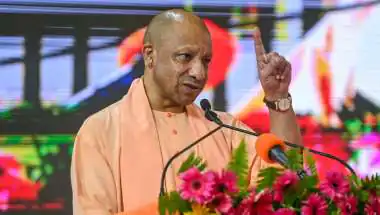
Vice President C.P. Radhakrishnan delivered one of the most direct and forward-looking addresses of the year on the future of Indian higher education from Kochi on Monday. Emphasising the changing demands of a technology-driven world, he made an unambiguous case for reimagining how India's colleges and universities prepare their students — arguing that education can no longer stop at the point of a degree.
"We just cannot produce graduates; we have to understand the demands of the market," he said, calling for a much stronger emphasis on research, innovation and problem-solving in India's education ecosystem.
The Occasion: Rajagiri's Silver Jubilee
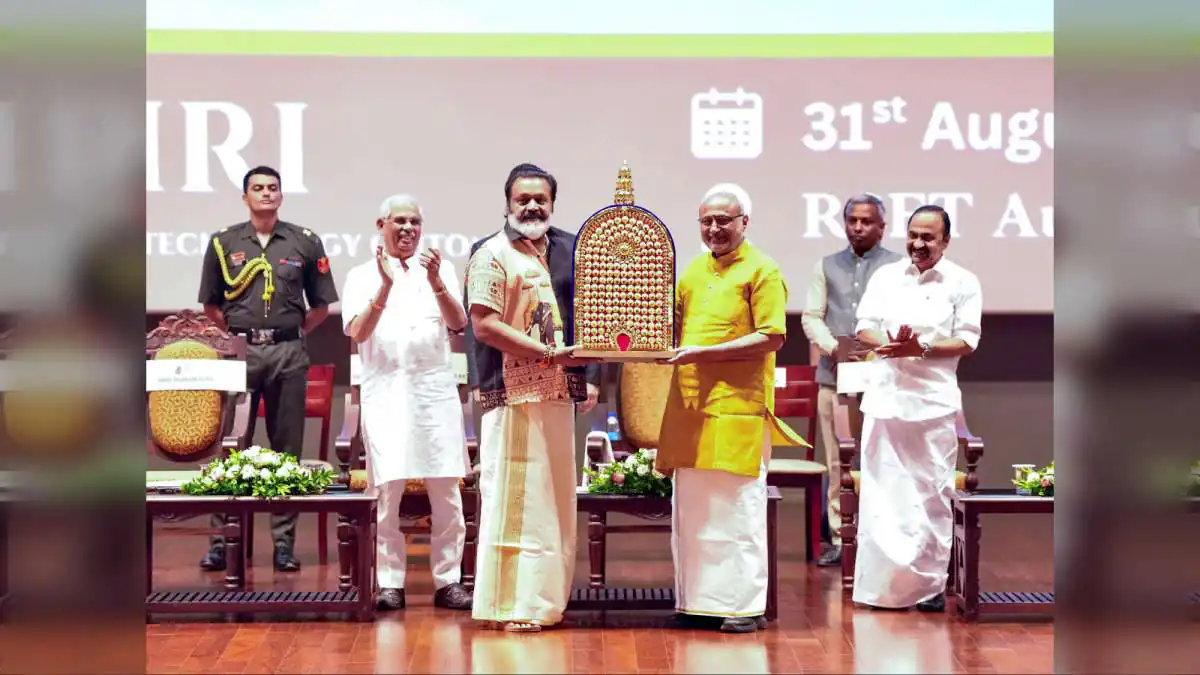
The Vice President made these remarks while attending the Silver Jubilee celebrations of Rajagiri School of Engineering and Technology (RSET) and inaugurating Confluence 3.0 — an Industry-Academia Summit built around the theme "India, Impact of AI." The setting itself was symbolic — a 25-year-old technical institution reflecting on its journey while stepping into the next chapter of India's AI-driven future.
Commending the Confluence 3.0 initiative, Radhakrishnan said stronger industry-academia partnerships are essential to make Bharat a global hub for technology and start-ups. He called for innovative teaching, interdisciplinary research, responsible use of AI and meaningful international collaborations — while insisting that all of this must remain rooted in Bharat's values.
Recognising Kerala's Educational Legacy
The Vice President warmly acknowledged Kerala's long-standing achievements in literacy, social development and human capital — factors that have historically distinguished the state within India's development story.
He said Rajagiri has contributed not only to producing technocrats but also leaders in public life, and congratulated the institution on completing 25 years. He appreciated its consistent commitment to combining values with technological excellence — the kind of balance that has always defined the best of Kerala's educational institutions.
Tribute to the CMI Legacy and Saint Kuriakose Elias Chavara
In one of the more historically rich portions of his address, Radhakrishnan recalled the contribution of the Carmelites of Mary Immaculate (CMI) and the legacy of Saint Kuriakose Elias Chavara. He highlighted their pioneering efforts in democratising education, promoting women's education and adult literacy, and ensuring that poverty and hunger did not become barriers to learning.
That acknowledgement placed Rajagiri's 25-year journey within a much longer arc — one that spans decades of educational reform led by the CMI congregation in Kerala.
The China Reference and the Case for Sustained Investment
Turning to comparative examples, Radhakrishnan referred to China's transformation over the past few decades — arguing that China's progress clearly demonstrates the importance of sustained investment in higher education, research and innovation.
He urged Kerala to strengthen research-oriented higher education and create an ecosystem that actively promotes innovation. That framing challenged both institutions and policymakers to think about higher education not just as a service delivery mechanism, but as a strategic economic asset.
A Direct Appeal for High-Tech Industry Focus
Making a specific appeal to the Chief Minister, VP Radhakrishnan flagged one of Kerala's most persistent economic challenges — its limited land availability and high land costs, which make large traditional industries difficult to scale in the state.
His answer was clear. He urged a greater focus on high-tech and knowledge-based industries — arguing that Kerala's strong educational base and talent pool can attract high-technology enterprises, create local employment, reduce migration and enable reverse migration.
That vision has significant implications. For a state that has long grappled with the reality of its skilled workforce leaving for opportunities elsewhere — from the Gulf to Bengaluru to global markets — a high-tech industry strategy could quietly reshape Kerala's economic future.
The 'Say No to Drugs' Appeal
Perhaps the most emotionally charged moment of the address was VP Radhakrishnan's direct message to young people. Recalling his own mother's advice during his childhood, he made a strong appeal to youth to "Say No to Drugs."
"Temporary pleasures can destroy great hopes and goals," he said, urging students to use their capabilities for the betterment of themselves, society and humanity.
That kind of personal, story-anchored appeal often lands harder than any policy statement — especially with young audiences at educational institutions.
A Foundation Stone for Rajagiri's Next Chapter
Beyond his address, VP Radhakrishnan also laid the foundation stone for the Administrative Block of Rajagiri School of Engineering and Technology — marking another visible milestone in the institution's continuing journey of growth and academic excellence.
The Dignitaries Present
The programme was attended by an impressive cross-section of Kerala's political and administrative leadership. The Governor of Kerala, Rajendra Vishwanath Arlekar; Chief Minister V.D. Satheesan; Union Minister of State for Petroleum and Natural Gas and Tourism Suresh Gopi; and Kerala's Higher Education Minister Roji M. John were among the dignitaries present, alongside the management, faculty and students of RSET.
The presence of both the Governor and the Chief Minister at a single institutional milestone speaks to the significance both Kerala's political leadership placed on the event and its broader message about education, research and industry alignment.
Why It Matters
VP Radhakrishnan's address distills one of the most important conversations happening across India's education ecosystem today. The country is graduating more students than ever, but employability, industry readiness and research culture remain persistent gaps.
By pointing out that "we cannot just produce graduates" — and by explicitly connecting that concern to industry-academia collaboration, research investment and AI-era readiness — the Vice President has given India's higher education leadership a clear articulation of the next phase of reform priorities.
Industry and Institutional Impact
For India's technical education institutions, the message is direct: adapt to a market that increasingly rewards research capability, interdisciplinary skills and problem-solving orientation. For state governments — particularly Kerala — the emphasis on high-tech industries provides a strategic vector that aligns naturally with the state's human capital strengths.
For students, the takeaway is equally sharp: degrees alone won't cut it in the coming decade. Skills, research exposure, and readiness to solve real-world problems will define the difference between a job seeker and a job creator.
Cultural Impact
The Vice President's acknowledgement of the CMI legacy and the pioneering work of Saint Kuriakose Elias Chavara also reminded the audience of an important truth — that many of India's most enduring educational institutions were built by visionaries who believed education could be an equaliser. That legacy continues to shape institutions like Rajagiri, and continues to inform the country's broader educational conscience.
The Bigger Picture
VP Radhakrishnan's Kochi address is more than a ceremonial jubilee speech. It is a policy signal, a strategic reminder, and a moral appeal — all delivered in a single visit. By linking industry-academia collaboration, AI responsibility, high-tech investment, women's education legacy, and the fight against youth drug abuse into one coherent message, he offered both a vision and a checklist.
As Rajagiri School of Engineering and Technology begins its 26th year, and as Kerala looks ahead to its next chapter of economic transformation, the address may well become a reference point for how India's higher education ecosystem must evolve. Because if there is one message that emerged loud and clear from Kochi on Monday, it is this: producing graduates is no longer enough. India needs institutions that produce innovators, researchers, problem-solvers and leaders — the kind that can build the country's future not just alongside global change, but at its very front.











.jpg)






























.jpg)