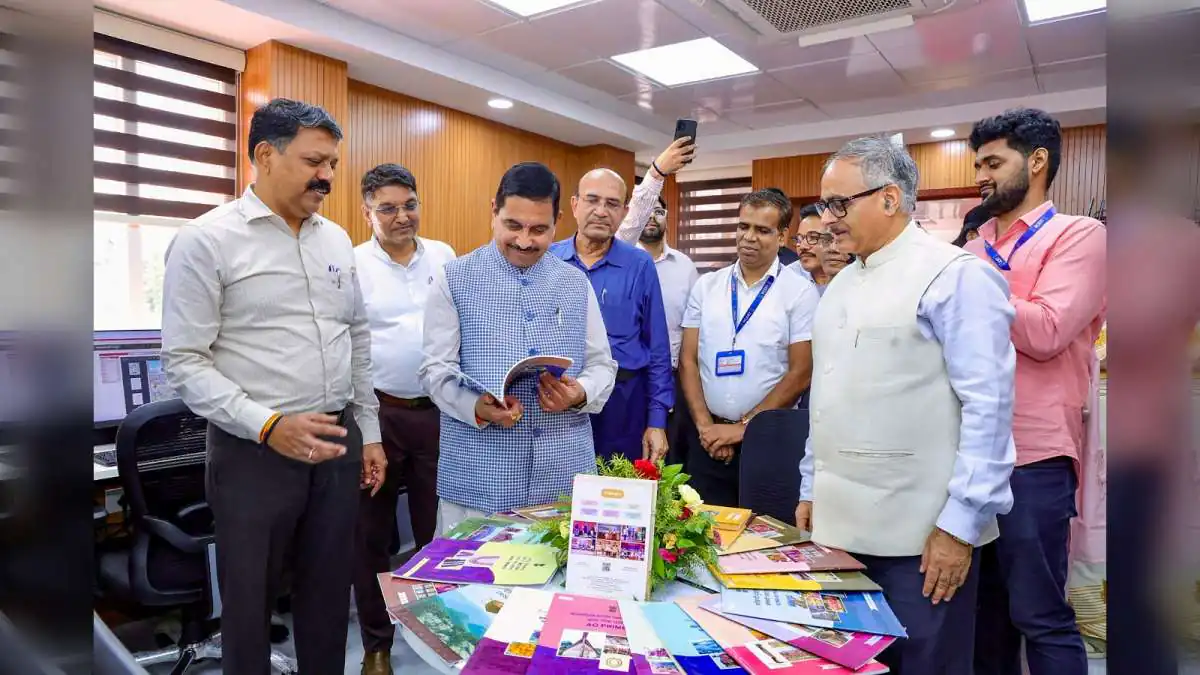
India's school education system is undergoing one of its most ambitious multilingual transformations in recent memory. On Tuesday, Union Education Minister Pralhad Joshi announced that school textbooks for Classes 1 to 8 are being prepared in 22 different languages of the country. Speaking at the National Council of Educational Research and Training's (NCERT) 66th Foundation Day celebrations, the Minister also unveiled a broader push to develop 122 foundational language materials — including 93 in tribal languages — reflecting a deep commitment to making education more accessible, inclusive and rooted in India's linguistic diversity.
For millions of young students across the country, particularly those whose home languages have historically been underserved by mainstream educational materials, this represents a genuinely meaningful shift.
The Central Announcement
Speaking at NCERT's Foundation Day event, Joshi laid out the scale of the multilingual initiative underway.
School textbooks for Classes 1 to 8 are now being prepared in 22 different languages of the country. Alongside this, 122 foundational language materials are being prepared in various Indian languages, including 93 tribal languages, to facilitate easy and comfortable adoption in respective course curricula.
That's a substantial number of language materials being developed simultaneously — reflecting the seriousness of India's push to align its education system more closely with the linguistic realities of the communities it serves.
Joshi noted that this would provide children with the opportunity to learn in their own languages and help extend education to diverse regions and communities across the country.
The NEP 2020 Anchor
The Minister anchored the multilingual push within the broader framework of the National Education Policy (NEP) 2020, which continues to serve as the guiding vision for India's education transformation.
Joshi said that NEP 2020 laid a strong foundation for comprehensive reforms in school education, with its focus extensively on holistic development, creativity, logical thinking, experiential learning and competency-based education.
That framing is important. It positions the current multilingual push not as a standalone announcement but as part of a coordinated, multi-year vision for redefining how school education is delivered in India.
Recognising NCERT's Legacy
Joshi took the opportunity of the Foundation Day event to celebrate NCERT's institutional legacy and its role in shaping Indian school education.
Lauding the role of NCERT in transforming the country's school education system and shaping the future of children, he said that it has been an integral part of the Indian education system for over six decades. He noted that NCERT's textbooks, study materials and curricular frameworks have contributed significantly to shaping school education across the country.
That's a well-deserved acknowledgment. NCERT has, over six decades, become one of the most influential institutions in the Indian education landscape — shaping curricula, generating pedagogical research, and building the foundational materials on which state-level educational systems have depended.
The Call for Continued Innovation
The Minister also used the platform to challenge NCERT to keep evolving, keep innovating and keep aligning itself with future needs.
Joshi called upon NCERT to foster greater innovation, inclusivity and research — and to bring about changes aligned with future educational requirements. He emphasised that the council must move forward in alignment with the evolving needs of education, building upon its more than six decades of experience and achievements.
That forward-looking framing reflects a recognition that education systems must continuously adapt. The world children are being prepared for today is not the same world their parents grew up in, and the tools NCERT provides teachers and schools must reflect that shift.
The New Skills That Matter
Perhaps the most forward-looking element of Joshi's address was his emphasis on the new set of skills that today's students need to develop alongside traditional subject knowledge.
The Minister said that imparting knowledge of traditional subjects is not enough for today's students. It is essential to equip them with skills such as digital literacy, an understanding of artificial intelligence, logical thinking, problem-solving and innovation.
That's a critical curriculum-shaping message. In an era where AI, digital tools and computational thinking are becoming foundational to virtually every career path, ensuring that Indian students graduate with strong exposure to these skills is genuinely important.
The Mental Health Component
In one of the most notable elements of his address, Joshi also highlighted students' mental health as a crucial component of the education system.
He noted that attention must be paid to children's mental wellbeing through appropriate curriculum changes and teachers' training. That acknowledgment — of mental health as central rather than peripheral to school education — reflects a growing global consensus that academic performance and emotional wellbeing are deeply interlinked.
For India's education system, integrating mental health awareness into curricula and teacher training programmes represents a meaningful step forward.
Why It Matters
Language is one of the most fundamental determinants of educational access. When children can learn in the language they speak at home, comprehension improves, engagement rises and confidence builds. When they cannot, education becomes a barrier rather than a gateway.
For India, home to hundreds of languages and dialects, developing textbooks and foundational materials in 22 languages — with additional support in 93 tribal languages — is not just a policy shift. It is a structural intervention aimed at ensuring that no child is left behind because of the language they were born into.
For tribal and linguistically marginalised communities in particular, this initiative represents a rare and deeply meaningful acknowledgment. It signals that their languages are not just being preserved as cultural artifacts but are actively being made central to their children's education.
Educational and Cultural Impact
For India's cultural fabric, the multilingual textbook push carries additional weight. Every language captures a distinct way of thinking, a distinct set of cultural references, and a distinct emotional register. Ensuring that education is delivered in these languages helps keep them alive, growing and relevant for the next generation.
For teachers, the availability of curriculum materials in local languages will also make classroom delivery significantly more effective — particularly in geographies where teachers already speak the local language but have historically had to work with textbooks in different ones.
For parents, the shift means their children can now bring school learning home and discuss it in the same language they use at the dinner table — deepening the connection between formal education and everyday family life.
Institutional Impact
For NCERT, coordinating the development of 122 foundational language materials — including 93 in tribal languages — is a substantial institutional undertaking. It requires linguistic expertise, cultural sensitivity, editorial rigour and close collaboration with community-level stakeholders across regions.
Successfully executing this initiative will strengthen NCERT's already significant institutional standing and provide a scalable template that can be extended further over time.
For India's broader education ecosystem — state governments, teacher training institutions, private publishers and NGOs working in education — the multilingual push creates new opportunities and responsibilities. It sets a new baseline for what inclusive educational content should look like in India.
Cultural Preservation Impact
There is also a deeper cultural preservation dimension to this initiative. Many of India's tribal and regional languages face genuine risks of decline if they are not actively integrated into everyday domains like education, media and administration. By deliberately investing in tribal language educational materials, the government is contributing directly to the vitality of these languages for the coming generation.
That's a legacy contribution that will pay dividends for decades.
The Bigger Picture
Union Education Minister Pralhad Joshi's Tuesday announcement is more than a routine ministry update. It reflects one of the most ambitious inclusive-education pushes India has undertaken in years — anchored in the National Education Policy 2020, powered by NCERT's institutional depth, and shaped by a genuine commitment to reaching every child in every language, region and community across the country.
Textbooks in 22 languages. Foundational materials in 122 languages, including 93 tribal ones. New emphasis on digital literacy, AI, problem-solving and mental health. And a clear directive to NCERT to continue innovating, evolving and expanding its impact.
For India's students, the message from Tuesday's announcement is clear. Your language matters. Your identity matters. Your future readiness matters. And the education system is being deliberately shaped to reflect all three.
For teachers, administrators, and educational institutions across the country, the coming months and years will bring the substantial work of implementation — ensuring that these new materials reach the classrooms they are designed for, in the format and language they are meant to be delivered in.
And for India as a whole, the vision behind Tuesday's announcement is one that could quietly reshape the country's educational and cultural future. Because when children are taught in the languages they think in, and when their curriculum is built to prepare them for both traditional knowledge and future skills, the result is not just better education. It is a stronger, more inclusive nation being built one classroom, one language, and one child at a time.
Also Read: Who Is Pralhad Joshi? Senior BJP Leader Given Charge of Education Ministry Following Dharmendra Pradhan's Exit





























.jpg)