











%20(5).jpg)





















%20(7).jpg)
.jpg)








%20(3).jpg)


Reflections on India’s Public Policies: By India’s Experienced Policy Makers
New Delhi (India), May 20: Reflections on India’s Public Policies’ is a labour of love crafted by a group of ten seasoned policy-makers of the 1984 batch who sift through their combined experience of over three centuries of reshaping the future of our country. From Finance to Land Usage, Education to Health, Sustainable Development to Energy, […]


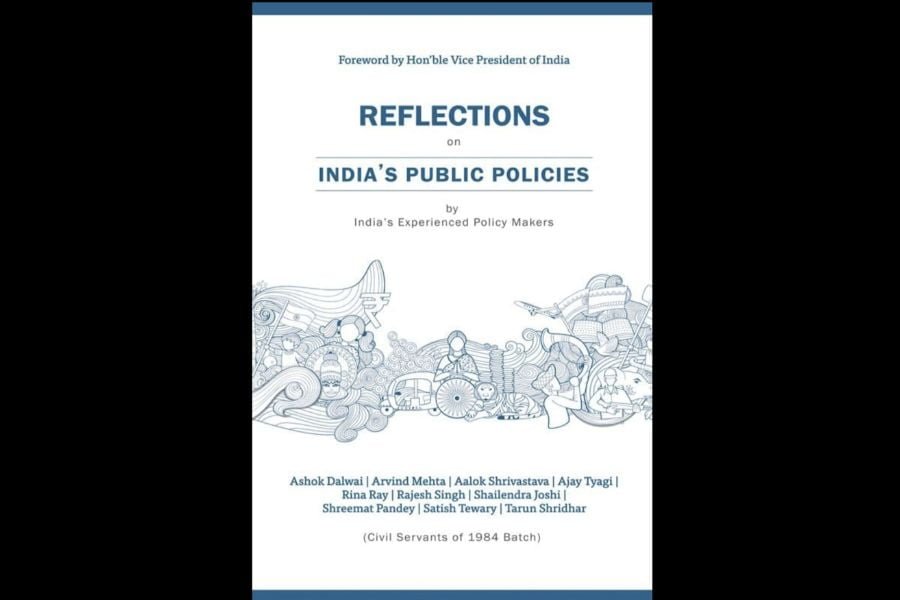

New Delhi (India), May 20: Reflections on India’s Public Policies’ is a labour of love crafted by a group of ten seasoned policy-makers of the 1984 batch who sift through their combined experience of over three centuries of reshaping the future of our country. From Finance to Land Usage, Education to Health, Sustainable Development to Energy, all the important factors that contribute to the growth of a nation are covered – succinctly and with great insight. The best part of this treatise is that it is written with a positive and forward-thinking approach. While identifying the most pressing issues faced by India, it does not just dwell on the problems. Instead, it offers simple, well-thought-of solutions, which are practical and efficacious – with hard evidence to back up the assumptions and concepts.
This book is different in another aspect. As most of the civil servants in India share their experiences at the personal level in the form of memoirs, there are only a few references in the public policy domain for sharing practical experiences in an objective manner. If one is looking for an objective analysis, this is the book. As more than 50% population of India still depends on the primary sector, the maximum coverage has been given to agriculture and allied subjects such as animal husbandry, fisheries, poultry, dairying and rural industrialisation. While dealing with the conservation of soil, land and water resources, attention had also been given to important social aspects such as preventing food loss and food wastage.
A major learning is that all forms of water harvesting structures are required in our country. As ‘small is beautiful’, so is the ‘big efficient.’ The book emphasises us remembering that water security is a fundamental requirement and investment is completely justifiable for such a basic public good. In so far as agriculture is concerned, it comes out clearly in the book that various inefficient subsidies kill the entrepreneurial spirit as the recovery of the cost of inputs has already been addressed. On the other hand, dairying, poultry and fish farmers need to work harder to recover the cost and generate a surplus to stay afloat. Innovation also gets pushed to the backseat, as the incentive to perform better has already been taken away from our agriculture policies.