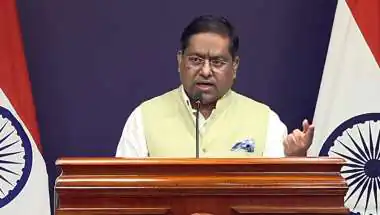
The scale of the tragedy unfolding along Nepal's Himalayan corridor is now official. Nepal's Foreign Minister Shisir Khanal on Wednesday confirmed that at least 300 Indian nationals — most of them pilgrims travelling to the Kailash Mansarovar Yatra — have been reported missing after the devastating flash floods that struck the Rasuwa region. The confirmation came during the NDTV World Anviksha Summit in Kathmandu and marks the highest-level acknowledgement so far of just how deeply the disaster has cut across Indian families.
Delivering a sobering assessment of the destruction, Khanal said 160 people had died and thousands remained untraced as authorities scrambled to piece together the full extent of the damage. However, the official death toll has since climbed further to 177 as more information trickles in from the ravaged region.
"Town after town were wiped out within hours," Khanal said. "Thousands of families have lost homes and are missing as of now. We are still trying to ascertain the full extent of the disaster." His words captured the terrifying speed of the event, in which entire settlements along the Nepal-Tibet border were reduced to debris within a matter of hours.
The India Dimension
For India, the most alarming detail was the confirmed number of missing pilgrims. "Foreign nationals, including Indians, take the route in the affected area to the Mansarovar Yatra. Close to 300 Indians have been reported missing and the government is trying to establish contact with them," Khanal said. Rasuwa serves as one of the key transit zones for the Mansarovar pilgrimage, placing a concentrated group of Indian citizens directly in the path of the disaster.
500 Foreign Nationals Out of Contact
The minister said that in total, around 500 foreign nationals are currently out of contact following the floods, as rescue and relief teams continue their operations across affected areas. Kathmandu is now in continuous coordination with the embassies of multiple countries regarding the safety and whereabouts of these missing foreign citizens — a scale of diplomatic engagement that reflects just how international this disaster has become.
India's Prompt Relief Effort Acknowledged
Khanal specifically thanked New Delhi for its swift response, describing the flash floods as one of the worst disasters to strike the Himalayan nation in recent times. "Right now the focus is on rescue and immediate relief. Many from across the globe are supporting and empathising with Nepal. Government of India has already sent relief. We express gratitude," he said. India's rapid dispatch of assistance mirrors its consistent role as a first responder in South Asian humanitarian crises.
Why It Matters
The Rasuwa disaster is fast emerging as one of the year's most significant trans-boundary humanitarian events. It has struck at the heart of a pilgrimage corridor sacred to Indian families, disrupted one of the most physically demanding spiritual journeys in the Hindu tradition, and drawn in embassies of countries across North America, Europe, Asia-Pacific and beyond. Beyond the immediate loss of life, it raises hard questions about disaster preparedness along high-altitude tourism and pilgrimage routes — questions that will only grow louder as climate-linked events intensify across the Himalayas.
An Appeal to Keep Visiting Nepal
Even as he detailed the destruction, Khanal made a pointed appeal to the international community: don't let the tragedy erase Nepal from the world's tourism map. "Beyond immediate relief, it is important that the world remain connected with Nepal and help us rebuild. Tourism is critical to our rebuilding efforts," he said. He stressed that the majority of Nepal remained unaffected, and most tourist areas — including Pokhara and the Mount Everest region — were open and safe for visitors.
"Request people to spend their tourism dollar in Nepal, which will help us rebuild over the next few months," he added — a candid reminder that Nepal's economic recovery depends heavily on visitor confidence being restored quickly.
A Nation That Has Rebuilt Before
Drawing on a powerful precedent, Khanal invoked Nepal's recovery from the catastrophic 2015 earthquake. "We have emerged stronger after past tragedies, most recently the big 2015 earthquake. Nepal will rebuild itself again," the minister said. It was a message aimed both inward and outward — a signal to Nepalis mourning today, and to the world watching from afar.
The Bigger Picture
The Rasuwa flash floods have quickly moved from being a regional disaster to a full-spectrum international emergency — with Indian pilgrims at its emotional core, diplomatic channels working overtime, and Nepal's own recovery hinging on both immediate rescue and long-term economic revival. For hundreds of Indian families still waiting for news, every hour is a stretch of unimaginable uncertainty. And for the wider Himalayan region, the disaster is one more warning that the era of climate-driven, fast-moving catastrophes has firmly arrived.











































.jpg.jpeg)